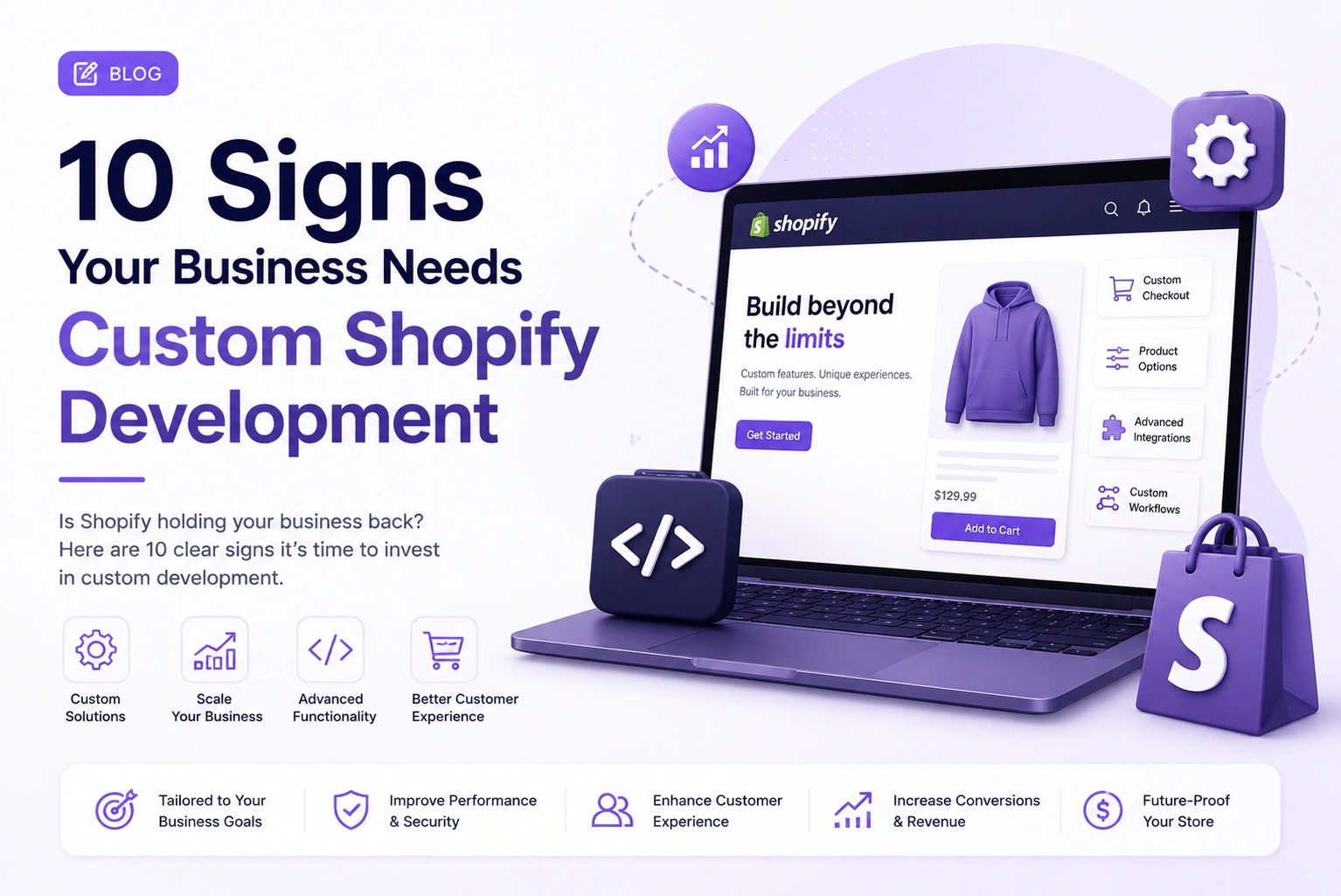
Standard Shopify is a great starting point when you are testing products, validating demand, or learning how ecommerce works. But as your business grows, prebuilt themes, apps, and default settings can limit how your store looks, performs, and supports customers.
If you want a more professional storefront, smoother buying experience, stronger integrations, or features built around your specific business needs, custom Shopify development could be the right choice.
In this article, we cover 10 signs your business needs custom Shopify development. This will help you decide whether your current setup is still enough or it is time to hire a Shopify expert.
Table of Contents
Top 10 Signs Your Store Needs a Custom Developer
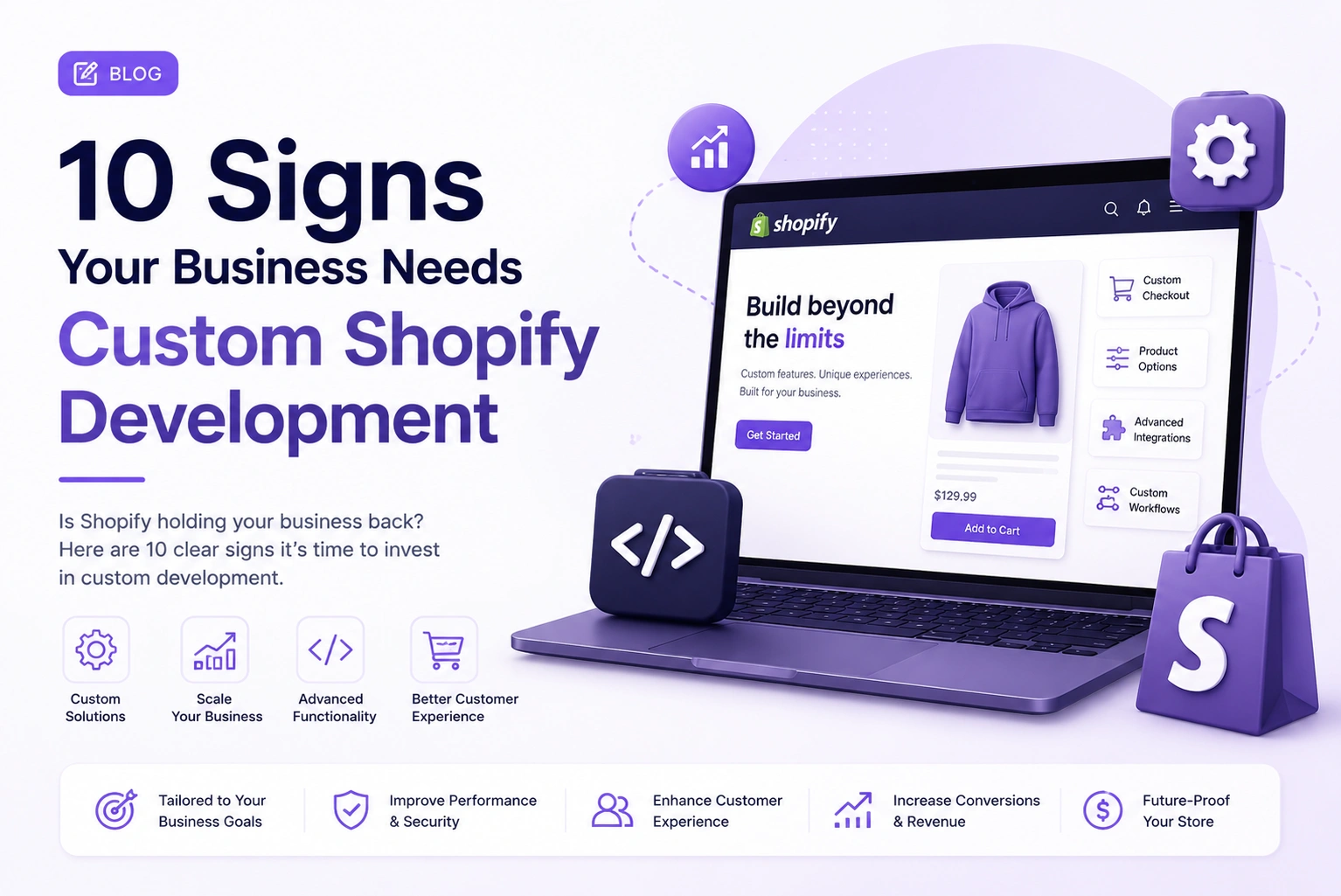
If you notice these signs in your store, start looking for a Shopify expert right away:
1. Your theme blocks conversion-critical features
Sign: You need a product-page feature or product-specific section, but can’t add it through the theme editor because your theme does not provide that option. Shopify merchants report encountering this exact limitation with both free and paid themes.
Standard themes only support their prebuilt sections and settings. Features such as compatibility checkers, advanced bundles, or interactive buying guides usually require custom code.
Business impact: Customers may struggle to compare products, select the right option, or get enough information to purchase confidently.
How custom development helps: A developer can build the required feature as a reusable section, block, or template without rebuilding the entire store.
2. Your store slows down as you add apps and features
Sign: Your store becomes slower after installing apps, page builders, tracking tools, or new theme features. Shopify merchants report speed-score drops and longer load times after adding storefront apps.
Apps can add JavaScript and third-party code. When several scripts load across every page, including where they are unnecessary, plug-and-play functionality creates avoidable overhead.
Business impact: Slower pages frustrate shoppers and can weaken discoverability and conversions.
How custom development helps: A developer can remove duplicate code, load scripts selectively, and replace multiple heavy apps with lighter custom functionality.
3. Your app stack is costly and difficult to maintain
Sign: You need separate apps for reviews, loyalty, bundles, translations, or other essential features, and the subscriptions quickly add up. Shopify merchants report facing this problem even shortly after launching.
Apps may also add storefront scripts and code. Shopify identifies installed apps as a major performance factor, while merchants report finding leftover code after uninstalling apps.
Business impact: You face higher recurring costs, slower pages, and more maintenance dependencies.
How custom development helps: Custom Shopify development can replace selected apps with lightweight, store-specific functionality.
4. Your products require more configuration than Shopify supports
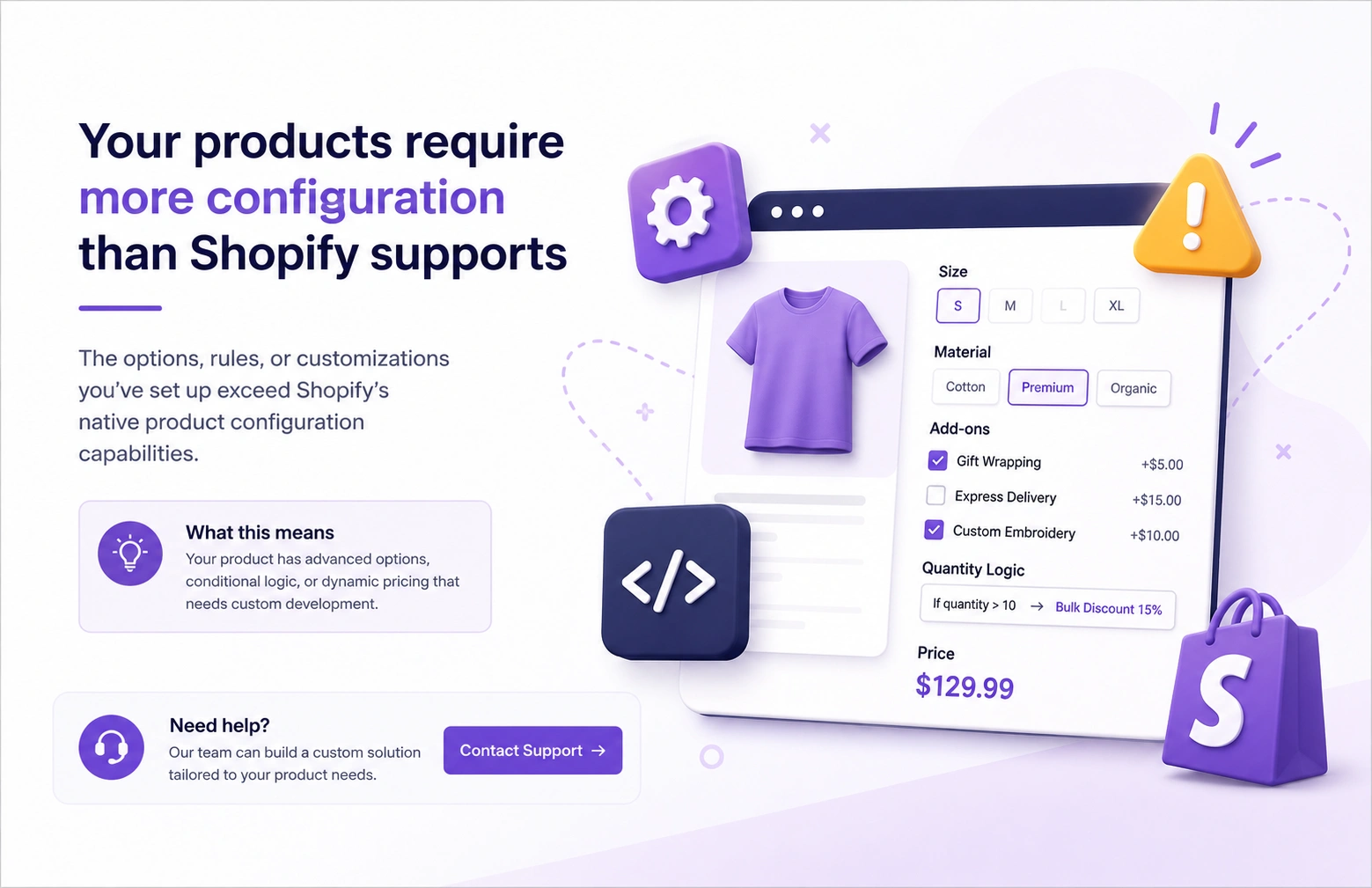
Sign: Your products need more than three options, conditional selections, or add-ons that change the final price. Shopify merchants often struggle to add fourth and fifth options with separate pricing.
Shopify’s native product structure supports up to three options per product, making complex configurators difficult to build without additional functionality.
Business impact: Customers may select incompatible options, receive incorrect pricing, or abandon a confusing product page.
How custom development helps: Custom Shopify development can create conditional option logic, dynamic pricing, and guided product configurators.
5. Customers cannot filter a large or complex catalogue effectively
Sign: Customers browse a large catalogue but cannot narrow products by important attributes such as size, compatibility, material, or specification. Filters may also disappear entirely once a collection becomes too large, forcing merchants to restructure their catalogue.
Shopify supports up to 25 filters, limits displayed filter values, and does not show filters on collections exceeding 5,000 products. Themes must also support Shopify’s filtering system.
Business impact: Customers take longer to find suitable products or leave without finding them.
How custom development helps: Shopify development can create catalogue-specific navigation, tailored filters, and a custom search experience.
6. Your business systems do not sync reliably with Shopify
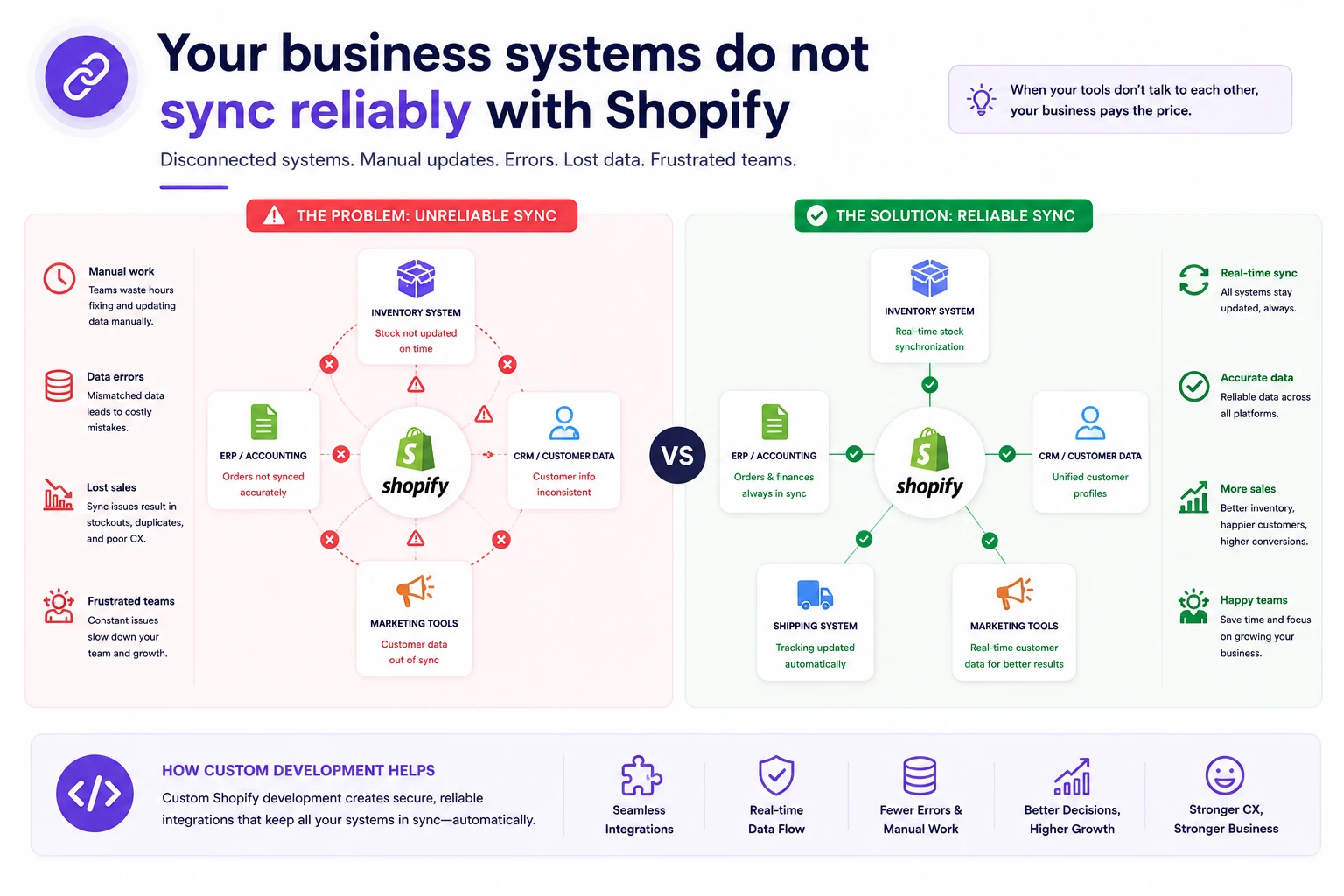
Sign: Employees manually re-enter inventory, orders, pricing, or customer data between Shopify and systems such as your ERP, PIM, CRM, WMS, or 3PL. Records may become outdated or inconsistent across platforms.
Shopify does not automatically exchange data with every external system; this requires a compatible app or API integration, which increases manual work.
Business impact: Manual work increases delays, duplicate records, stock errors, and fulfilment mistakes.
How custom development helps: Custom Shopify development can connect your systems and automate data exchange using APIs and webhooks.
7. Your B2B workflows exceed Shopify’s native setup
Sign: Wholesale buyers need company-specific catalogues, pricing, order minimums, payment terms, or approval workflows that your current setup cannot manage consistently.
Shopify supports core B2B features, but Basic, Grow, and Advanced plans allow only three active catalogues. More complex quote, invoicing, and order-field requirements may still require multiple apps or custom logic.
Business impact: Staff manually adjust orders and pricing, increasing errors and slowing sales.
How custom development helps: Shopify development services can build tailored pricing rules, approvals, portals, and B2B workflows.
8. Your checkout rules are too complex for standard settings
Sign: You need discounts, delivery options, payment methods, or purchase restrictions to change based on the customer, products, location, or cart conditions. But standard checkout settings cannot support the required logic.
Shopify Functions can add custom discounts, delivery and payment rules, and cart validation. However, interface customisations within the information, shipping, and payment steps require Shopify Plus.
Business impact: Customers may see incorrect options, while staff manually review or correct orders.
How custom development helps: Custom Shopify development can implement conditional checkout logic through Functions and checkout extensions.
9. Theme updates repeatedly break your customisations
Sign: Theme or app updates cause layouts, cart behaviour, or custom features to stop working, so your team delays updates or repeatedly reapplies code.
Shopify confirms that conflicting code edits may not carry into a new theme version and must be copied manually. Repeated undocumented edits by apps or developers make the theme harder to update and troubleshoot.
Business impact: Maintenance takes longer, releases slow down, and storefront errors may disrupt browsing or checkout.
How custom development helps: A Shopify expert can refactor the theme into documented, modular components and establish version control and testing.
10. Your workarounds cost more than a custom solution
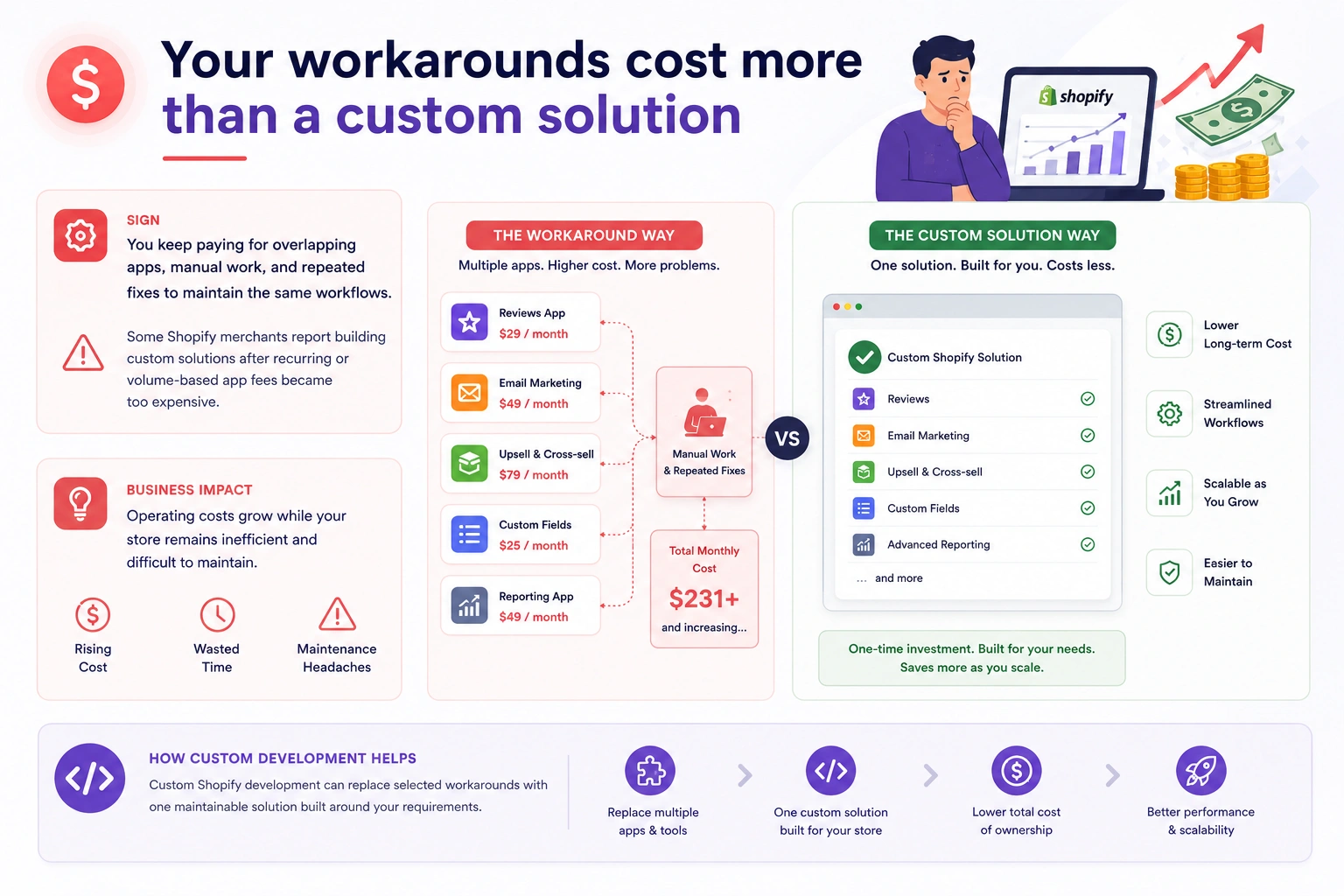
Sign: You keep paying for overlapping apps, manual work, and repeated fixes to maintain the same workflows. Some Shopify merchants report building custom solutions after recurring or volume-based app fees became too expensive.
Shopify apps can charge recurring, usage-based, or one-time fees, so costs may rise as your store scales.
Business impact: Operating costs grow while your store remains inefficient and difficult to maintain.
How custom development helps: Custom Shopify development can replace selected workarounds with one maintainable solution built around your requirements.
How Aron Web Solutions Can Help?
If you have noticed more than 3 of the above signs in your Shopify store, you should look for custom Shopify development services or hire a Shopify expert.
But don’t choose a provider based on the cheapest quote or biggest promises. Look for relevant case studies, experienced Shopify developers, verified client reviews, clear project scope, and transparent communication about cost and timelines.
Aron Web Solutions fits these criteria, with Shopify development experience, published case studies, and verified client feedback.
Whether you need a custom feature, integration, theme improvement, or complete build, Shopify experts at Aron Web Solutions can create the right solution without pushing unnecessary development.
Book a call now to see how our Shopify experts can help.
Disclaimer: This is not a sponsored or promotional blog post. All recommendations and insights are drawn from our team’s direct experience.
Frequently Asked Questions (FAQs)
Custom Shopify development means creating or modifying store functionality beyond what Shopify’s standard themes, settings, and ready-made apps can provide.
It may include custom themes, product features, apps, integrations, checkout logic, or search experiences created around a business’s specific requirements.
Any business for which standard themes, apps, or settings cannot support the required design, functionality, integrations, or workflows can go for custom Shopify development.
Custom Shopify development costs vary depending on the project scope, feature complexity, integrations, design requirements, store size, and more. To get a free custom quote, reach out to Aron Web Solutions.