Most businesses struggle to manage customer inquiries outside regular working hours. Some try to operate around the clock anyway, while others simply lose potential customers to competitors due to delayed responses.
Smart businesses, however, are turning to a better solution: AI chatbots. These are conversational systems that handle customer interactions even when you're away. The process of planning, building, and launching these systems is called AI chatbot development.
So what is an AI chatbot, exactly? What benefits can it deliver, and how much does it cost to develop one? This guide breaks it all down. Read on.
Table of Contents
What is an AI chatbot?
An AI chatbot is a software application powered by artificial intelligence that can understand, process, and respond to human language in a natural and conversational manner.
Nearly two-thirds of customers prefer chatting with a chatbot over waiting for human assistance.
Unlike traditional rule-based chatbots that follow predefined scripts, AI chatbots use technologies such as natural language processing (NLP) and machine learning to interpret user intent, answer questions, and provide relevant responses in real time.
AI chatbots are widely used across websites, mobile apps, messaging platforms, and customer support channels to automate interactions, assist users, and improve operational efficiency.
For instance, in the retail industry, chatbots can handle up to 70% of customer inquiries, enabling support teams to dedicate more time and attention to complex customer issues.
What Is AI Chatbot Development?
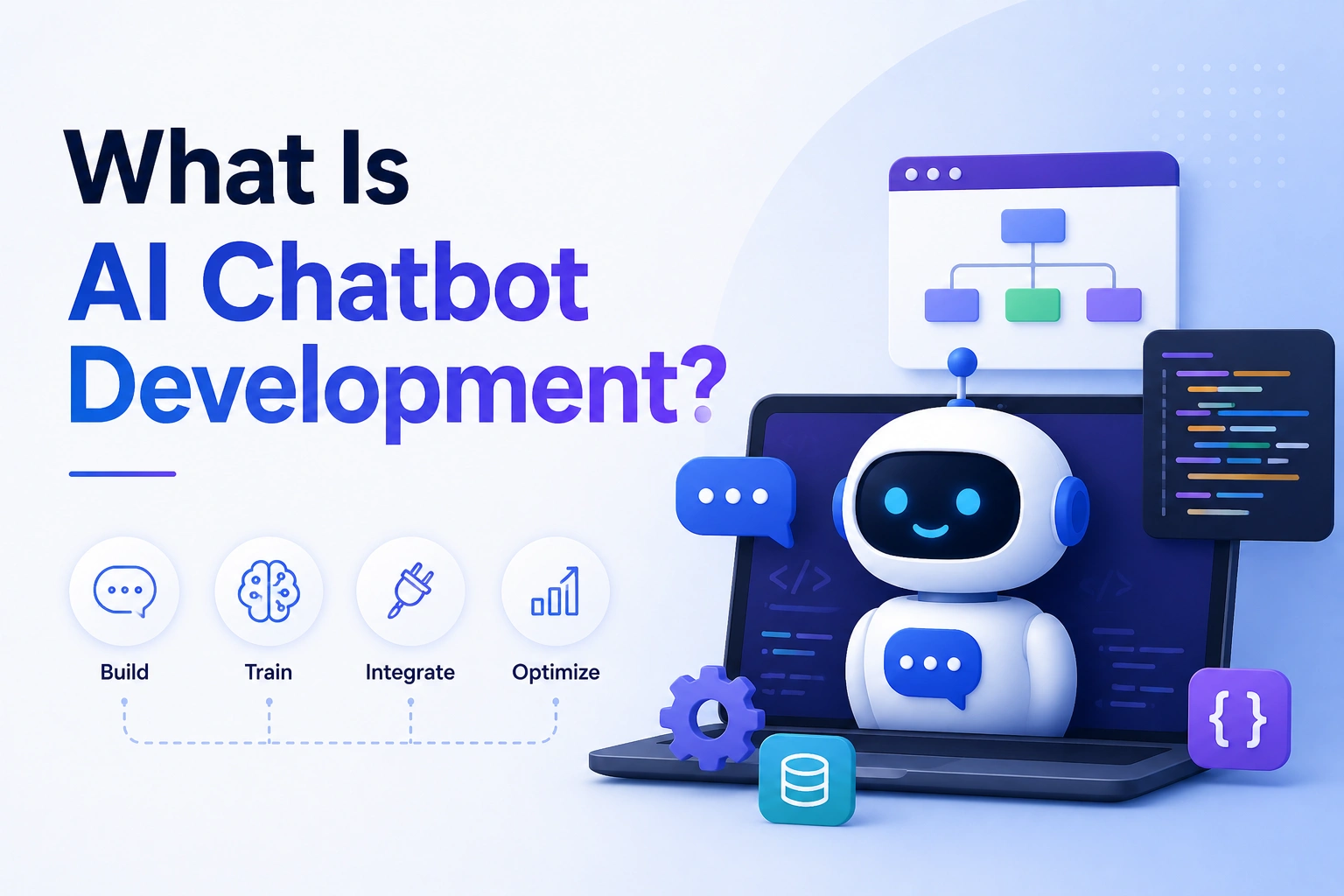
AI chatbot development is the process of building conversational systems that automate repetitive customer interactions, reducing the need for human agents to handle routine queries.
For instance, a customer support chatbot can instantly answer FAQs, track orders, schedule appointments, and qualify leads 24/7, enabling businesses to serve more customers without proportionally increasing support staff.
Why Using AI Chatbots is Crucial in 2026?
It's 2026, and most businesses have already adopted chatbots to automate their operations. It's high time you did too, if you haven't already.
Here are some of the key benefits businesses gain from implementing AI chatbots:
1. Reduced Customer Support Costs
Hiring and training support staff can become expensive quickly. AI chatbots handle routine queries automatically, cutting staffing needs and operational overhead while maintaining consistent service quality across every customer interaction.
2. Faster Response Times
Customers expect answers in seconds, not hours. AI-powered chatbots respond instantly with accurate information, eliminating wait times and reducing the frustration that drives customers toward competitors.
3. Enhanced Operational Efficiency
Manual processes eat up time that could go toward higher-value work. Chatbots automate repetitive tasks like order tracking and FAQs, freeing your team to focus elsewhere.
4. 24/7 Customer Support Availability
Customers don't only have questions during business hours. AI chatbots provide round-the-clock coverage, capturing leads and resolving issues overnight, on weekends, and across time zones.
5. Valuable Customer Insights
Without data, you're guessing what customers actually want. Chatbots track every interaction, surfacing patterns in queries and pain points that inform better product and support decisions.
6. Scalable Customer Support Operations
Seasonal spikes or viral moments can overwhelm support teams. Scalable AI chatbot development lets you handle thousands of simultaneous conversations without added headcount or response delays.
Below is a Reddit user highlighting his viewpoint on the benefits of using chatbots.
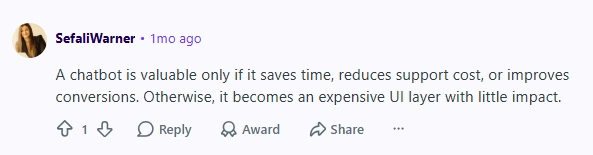
Source: Reddit
AI Chatbot Development Process
Here’s what an AI chat development process typically involves:
| Stage | Description |
|---|---|
| Discovery and Requirement Gathering | Understand business goals, target users, and chatbot requirements to define the project scope. |
| Planning and Solution Design | Create a chatbot strategy, conversation flows, and technical architecture tailored to business needs. |
| Chatbot Development and Training | Build the chatbot and train it using relevant data to deliver accurate, context-aware, and meaningful responses. |
| Integration with Existing Systems | Connect the chatbot with CRMs, databases, APIs, payment gateways, and other business tools for seamless functionality. |
| Testing and Quality Assurance | Evaluate the chatbot for accuracy, performance, security, usability, and reliability before deployment. |
| Deployment and Launch | Launch the chatbot across websites, mobile apps, messaging platforms, and other customer touchpoints while ensuring a smooth and reliable user experience. |
| Continuous Monitoring and Optimization | Track chatbot performance, analyze user interactions, gather feedback, and implement ongoing improvements to enhance effectiveness. |
Ready to build an AI chatbot for your business?
Talk to our team, and we'll map out exactly what your project would involve.
AI Chatbot Development Cost Breakdown
Estimated AI chatbot development cost in India by project type:
| Chatbot Type | Estimated Cost Range (INR) |
|---|---|
| Basic FAQ Chatbot | ₹15k – ₹50k |
| Lead Generation Chatbot | ₹25k – ₹75k |
| Customer Support Chatbot | ₹50k – ₹1.5L |
| WhatsApp AI Chatbot | ₹50k – ₹2L |
| E-commerce AI Chatbot | ₹1L – ₹5L |
| Custom Generative AI Chatbot | ₹2L – ₹15L |
| Enterprise AI Chatbot | Custom Quote |
These ranges reflect typical market pricing in India and can vary depending on the agency, tech stack, and project scope.
At Aron Web Solutions, our pricing generally falls within these industry ranges, with basic implementations starting from ₹15k.
Where your project lands within that range depends on your specific features, integrations, and AI capabilities. Contact our team for a custom quote tailored to your specific business requirements.
Factors Affecting AI Chatbot Development Costs
The cost of the AI chatbot development process is governed by several factors, such as complexity, AI requirements, etc., and it's important to understand these factors in order to make the right decision when hiring a chatbot expert agency. Below are some of the key factors that need your attention:
Chatbot Complexity
A simple rule-based chatbot that answers FAQs costs far less than one that handles multi-turn conversations, context retention, and dynamic decision trees. The more sophisticated the conversation flow, the more development and testing hours are required.
AI and NLP Requirements
Chatbots using advanced natural language processing, sentiment analysis, or intent recognition require specialized AI models and larger training datasets. Costs rise with the need for multilingual support, custom NLP training, or integration with large language models.
Number of Integrations
Connecting the chatbot to CRMs, payment gateways, databases, helpdesk tools, or third-party APIs adds development complexity. Each integration requires custom coding, testing, and ongoing compatibility checks, increasing overall cost.
Custom Features and Workflows
Features like personalized recommendations, voice support, appointment scheduling, or automated workflows tailored to specific business logic add significant development time. The more unique and tailored the functionality, the higher the engineering effort.
Deployment Platforms
Building a chatbot for a single platform (like a website) costs less than deploying across multiple channels such as WhatsApp, Facebook Messenger, Slack, and mobile apps. Each platform may require unique APIs, design adjustments, and testing.
Data Security and Compliance Requirements
Chatbots handling sensitive data (healthcare, finance, personal information) need encryption, secure authentication, and compliance with regulations like GDPR or HIPAA. Meeting these standards adds extra layers of development, auditing, and legal review.
Ongoing Maintenance Needs
Post-launch costs include bug fixes, model retraining, performance monitoring, and feature updates to keep the chatbot effective over time. Chatbots that rely on evolving AI models typically need more frequent and costly maintenance cycles.
Why Partner with Aron Web Solutions for AI Chatbot Development?
Here's where Aron Web Solutions stands out:
1. Experience across industries and use cases. We've built chatbots ranging from simple lead-capture bots for service businesses to complex, integration-heavy systems for e-commerce and enterprise clients.
As an example, we developed a working AI shopping assistant for Shopify stores that goes beyond answering questions: it pulls live product and pricing data from the merchant's catalog, recommends products with real reasoning ("this one's a better fit because..."), and lets shoppers add items to cart and move toward checkout without leaving the chat.
That range means we've already worked through the edge cases your project is likely to run into, rather than figuring them out for the first time on your dime.
2. Technical depth beyond off-the-shelf templates. Our team works directly with NLP, machine learning, and large language models, not just no-code chatbot builders, so we can build genuinely custom logic, context handling, and integrations when your use case demands it, rather than forcing your business into a generic template's limitations.
3. Transparent pricing, no surprise scope creep. The cost ranges in this guide aren't theoretical; they reflect how we actually scope and quote projects. You'll know what you're paying for before you commit, and we'll flag upfront if your requirements push a project into a different complexity tier.
4. Support that doesn't end at launch. A chatbot's first version is rarely its best version. We monitor performance, retrain models, and refine conversation flows after deployment, so the bot keeps improving as you learn more about how customers actually use it.
If you're evaluating us against other agencies, the fastest way to find out if we're the right fit is to talk to us directly about your specific requirements rather than match generic criteria against a sales page.
Conclusion
AI chatbots have moved well past the simple FAQ bots businesses experimented with a few years ago. The real shift now is in how naturally these systems understand context, hold a conversation, and actually resolve a customer's problem instead of just routing it somewhere else.
That's the gap we close: turning a generic chatbot template into something that fits how your business actually operates, talks to customers, and grows.
If you're weighing whether to build that in-house or bring in specialists, the deciding factor usually isn't the technology itself; most teams can wire up an API. It's the strategy, integrations, and ongoing tuning that separate a chatbot customers tolerate from one they actually find useful.
This is where agencies like Aron Web Solutions fit in: not in writing the first version, but in getting it right after the first hundred real conversations.
Disclaimer: This is not a sponsored or promotional blog post. All recommendations and insights are drawn from our team’s direct experience.
Frequently Asked Questions (FAQs)
These chatbots work on many platforms, including websites, mobile apps, customer support portals, social media channels, and messaging platforms like WhatsApp, Facebook Messenger, and Slack.
The development timeline depends on the complexity of your requirements, integrations, and AI capabilities. A basic chatbot can typically be developed within 2–4 weeks, while more advanced AI-powered chatbots with custom integrations may take 6–12 weeks or longer.
Developers using generative AI are responsible for building solutions that are accurate, secure, ethical, and compliant with data privacy regulations. They must ensure that AI-generated responses are monitored, tested, and aligned with business objectives while minimizing risks such as misinformation, bias, and unauthorized use of sensitive data.
An AI chatbot development company builds, designs, and deploys conversational systems (referred to as chatbots) that answer customer queries in real time. These agencies automate the process of responding to customer queries, freeing your business to focus on other priorities.
With so many options and platforms available online, it's difficult to know which one to trust with your project. While complete assurance only comes through real collaboration, knowing a few key factors, such as experience, client feedback, technical knowledge, and communication, upfront can help you avoid costly mistakes.